


How Much Does Google Ads Cost for an Online Store? (2026 Budget Guide)

Author
TWOads Agency 4 min read
  21 July, 2026
Quick answer
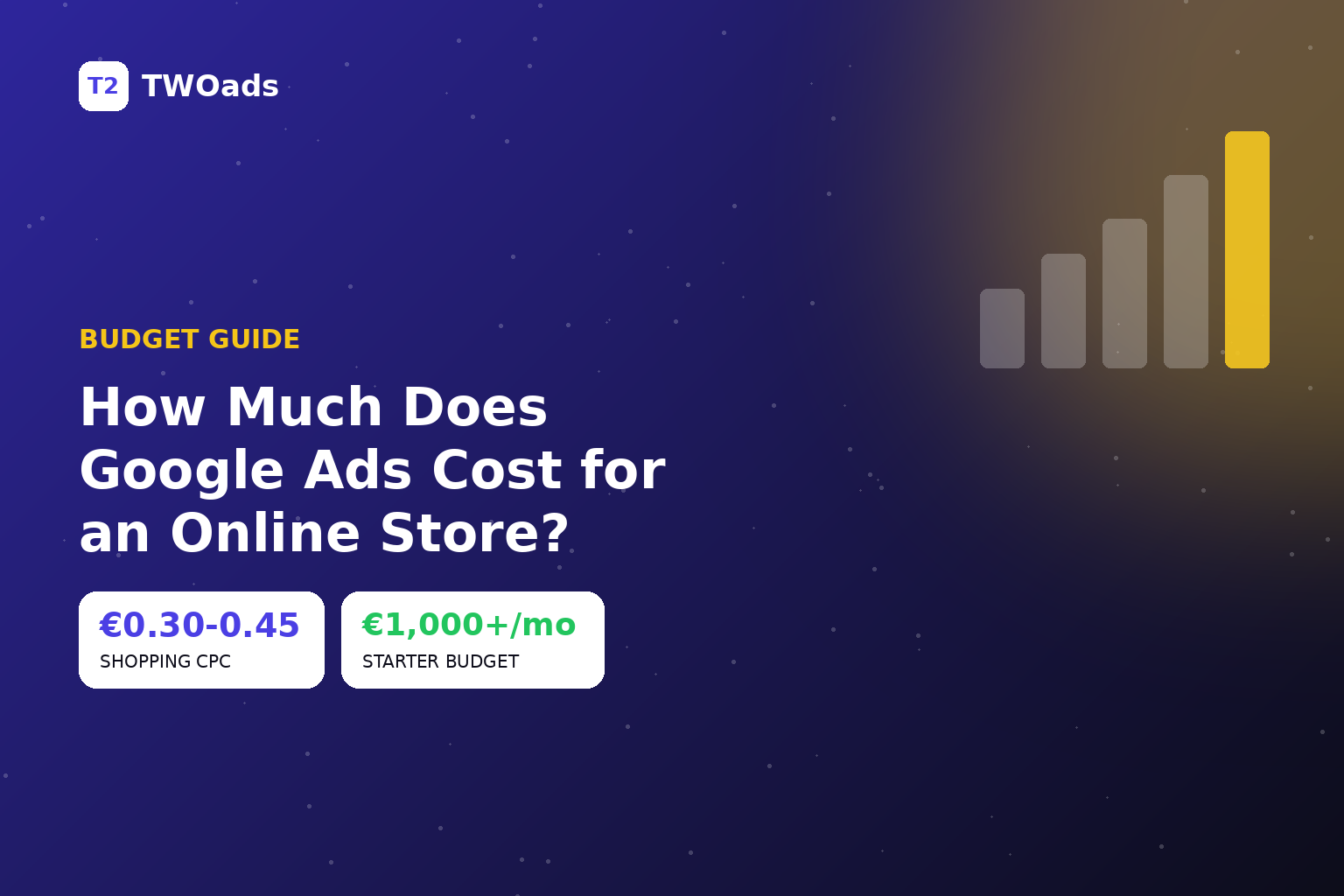
For a European e-commerce store, expect an average cost per click of roughly €0.35–€0.45 for Shopping and Performance Max campaigns, and €0.40–€0.60 for Search campaigns, though this varies significantly by niche and competition. Most small-to-mid online stores start seeing reliable data with a monthly ad budget of €1,000–€3,000, and scale from there based on margin and order volume. There is no fixed minimum — Google Ads has no required spend — but under-budgeted accounts struggle to exit the algorithm’s learning phase, which typically needs a meaningful volume of conversions within 30 days to optimize properly.
What determines how much you’ll pay per click?
Google Ads runs on a real-time auction. Your actual cost per click (CPC) depends on:
- Competition in your niche — a saturated category (electronics, fashion) costs more per click than a niche one (specialty tools, local products)
- Quality Score — Google’s 1–10 rating of your ad relevance, expected click-through rate, and landing page experience; higher Quality Score directly lowers CPC
- Campaign type — Shopping and Performance Max (Feed Only) tend to have lower CPCs than Search, because the ad format itself (product image + price) pre-qualifies clicks
- Geographic targeting — advertising across all of Europe costs differently than targeting a single country
- Whether you route through a CSS partner — see below
Typical CPC ranges for European e-commerce (2026)
| Campaign Type | Typical CPC Range (EU) |
|---|---|
| Google Shopping | €0.30 – €0.45 |
| Performance Max (Feed Only) | €0.35 – €0.50 |
| Search | €0.40 – €0.70 |
| Display | €0.10 – €0.25 |
These are general ranges across niches — competitive categories like electronics or legal-adjacent products run higher, while low-competition niches run lower. Your own account’s CPC is the only number that actually matters for your budget planning; use these ranges as a sanity check, not a target.
The CPC lever most stores don’t use: Google CSS
One factor that directly changes your CPC — and that most online store owners have never heard of — is routing your Shopping and Performance Max campaigns through a certified Google CSS (Comparison Shopping Service) partner instead of the default Google Shopping channel. Google applies an automatic ~20% CPC discount to campaigns run through an independent CSS. Same auction, same placement, same click — just a lower price.
Read more: What Is Google CSS and How Does It Lower Your CPC?
How much budget do you actually need?
Budget planning works backward from your numbers, not forward from a generic rule of thumb:
- Know your margin. If you sell a product with a 40% margin at €50, you can afford to spend up to €20 in ad cost per sale before you’re unprofitable — that’s your ceiling, not your target.
- Estimate your conversion rate. E-commerce sites typically convert somewhere between 1–3% of ad clicks into sales, though this varies heavily by price point and niche.
- Work out cost per acquisition (CPA). If your average CPC is €0.40 and your conversion rate is 2%, your rough CPA is €0.40 ÷ 0.02 = €20 per sale.
- Multiply by target order volume. Want 50 orders a month at a €20 CPA? Budget roughly €1,000/month, then adjust based on real performance.
- Add a buffer for the learning phase. New campaigns need meaningful conversion volume within their first 30 days to optimize — an under-funded launch often looks like a failed campaign when it’s really just a data problem.
Is a bigger budget always better?
No. Google Ads performance runs into diminishing returns once a campaign has exhausted the available high-intent search volume in its niche — beyond that point, extra budget buys lower-intent clicks at a worse CPA. In practice, most accounts get more value from feed and targeting optimization than from budget increases once they’re past the initial data-gathering phase. In one TWOads account in the IT&C niche, cutting the budget by ~6% while restructuring the feed and switching to a CSS partner still tripled revenue — proof that spend isn’t the only lever, and often isn’t even the main one.
Read more: IT&C Case Study: How We Tripled Sales and Grew ROAS to 4.54 in 30 Days
Fixed retainer vs. commission-based pricing: what does managing the account cost?
Separate from your ad spend (paid to Google), you’ll also typically pay for account management, either as:
- A fixed monthly retainer — common with traditional agencies, charged regardless of results
- A performance-based commission — a percentage of the sales the campaigns generate, which ties the agency’s incentive directly to your results
Read more: How to Promote Your Online Store on Google Ads With No Fixed Costs
Summary: what to budget as a new online store
| Store Stage | Suggested Starting Monthly Ad Budget |
|---|---|
| Pre-launch / testing | €500 – €1,000 |
| Early growth (some sales history) | €1,000 – €3,000 |
| Scaling (proven margins, repeat customers) | €3,000+ |
These are starting points to gather enough data to optimize, not fixed rules — your actual ceiling is set by your margin, not by a generic budget recommendation.
Not sure what your account should actually be spending? Contact TWOads for a free Google Ads and Merchant Center audit.
Contact

Thank you for your message!
We're excited to help you. We will contact you as soon as possible!